Can Montessori and Other Curriculums Co-Exist? (A Case Study)
This week, one of our focus areas was sentence development and expansion. We started by discussing the main reason for practicing writing: It allows us to organize our thoughts clearly so that we can share them effectively. (It’s valuable to have these discussions with children, because buy-in and self-discipline can only arise if they know how the activity is benefiting them in the short- and long-term.)
The first work we did was a review of the Montessori Sentence Analysis adverbial material. I wrote a kernel sentence (a simple sentence) that consisted of subject, predicate, and direct object, and I invited the children to analyze it. (The sentence was relevant to Geography work the children had just completed, which is a great way to bring cultural subjects into Language Arts work.)
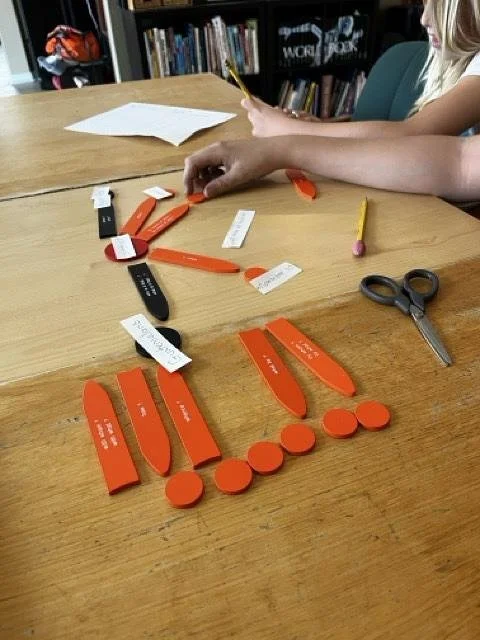
Then I pointed out how boring my sentence was, explained that they knew a lot more on the topic, and asked the children to expand the sentence using the adverbial arrows. I set a limit of four arrows (because this activity can otherwise get out of control) and I let them choose their adverbials.
They worked together to expand the sentence, and then we talked about possible orders for the adverbial phrases. The original sentence was: Guatemalans create giant kites. Their expanded sentence became: On November 1st, Guatemalans in Sempango create giant kites out of bamboo and paper to celebrate All Saints Day.
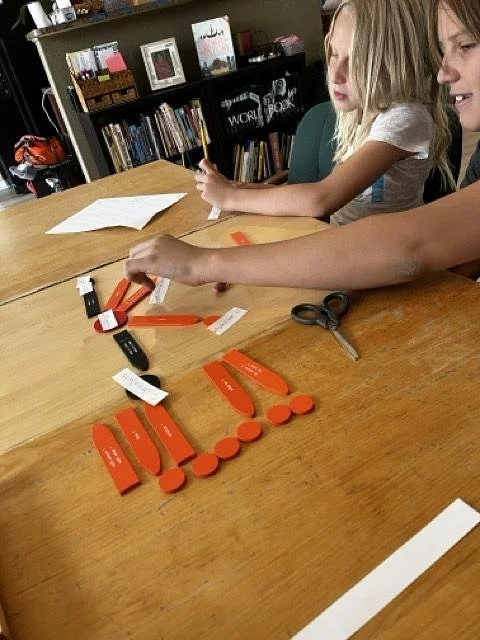
We also transposed the phrases (switched them around) to see if they would work in a different order. It’s always interesting to hear their perspectives, and it’s reassuring to observe how children have an intuitive understanding of phrase ordering (honed by years of listening to quality read-alouds and audiobooks). It’s not something you have to explicitly teach, but it does help to bring it to their awareness by saying something like: “Isn’t it interesting how the phrase that answers ‘when’ sounds best at the beginning of the sentence? I wonder if that’s the case for other sentences? Let’s try another one…”
Z (12) was willing to analyze the parts of the expanded sentence on the Sentence Analysis recording document (included in the lesson sequence), but N (9) made it very clear that she wasn’t interested in writing on paper. Rather than fight her (parent, know thy child) I invited her to help me on the board. This was much more pleasing to her, so we partnered up. I wrote each question and she wrote the answer and defined the part of the sentence to which each word or phrase corresponded.
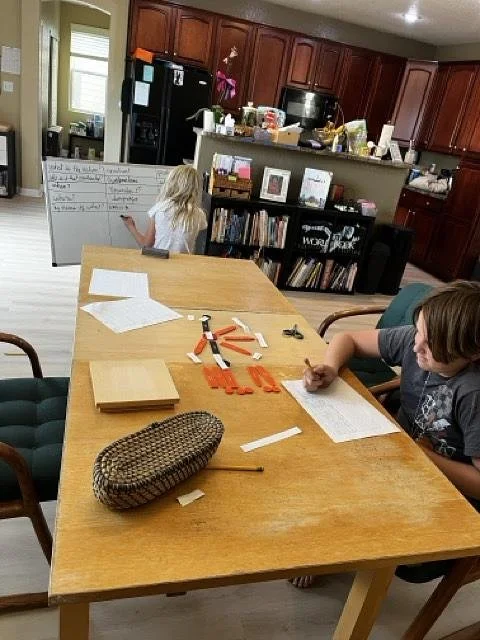
The next day, as an extension, I introduced a Sentence Expansion activity from a writing curriculum called The Writing Revolution. It’s basically the same idea, except without the visual and sensory elements of the Sentence Analysis material (and without providing an understanding of the names of the parts of the sentence).
I asked the children to recall the questions on the backs of the arrows (informal assessment!), and I wrote them down as they told them to me. Then I wrote a kernel sentence on the whiteboard and asked them to choose three questions that they could use to expand the sentence. I wrote their three questions below the kernel sentence, and next to the questions I wrote the children’s answers. And then I invited them to dictate to me the expanded sentence.
We repeated the above-mentioned process with three different kernel sentences, and then I invited them to come up with two kernel sentences on their own and follow the process independently on paper. This activity was really easy for them, because of the strong foundation that Montessori Language work has given them.
I’d been hearing a lot about The Writing Revolution, so I thought I’d see what the fuss was all about. The book claims to be “a guide to advancing thinking through writing in all subjects and grades.”
I found some of the activities to be a good supplement to the Montessori writing progression, and the later work on crafting a five-paragraph essay is helpful for upper elementary and adolescent writers. But honestly, the sentence-writing work doesn’t hold a candle to the early elementary Montessori Sentence Analysis activities in terms of supporting depth of understanding, critical thinking, and creativity.
So yes, Montessori and other curriculums can co-exist, in large part because Montessori is much, much more than a mere curriculum - it’s an entire educational philosophy. Waldorf, Charlotte Mason, The Writing Revolution, Handwriting Without Tears, and other quality resources have a lot to offer as supplements to the time-tested, scientifically-designed materials, lessons, and principles that make up the Montessori approach.
The Montessori Elementary Timeline curriculum will boost creativity and critical thinking in your homeschool, with lessons your children will actually want to engage in. It covers the six main academic subjects for ages 5-12 and includes the complete collection of Montessori writing lessons. Click here to learn more.